
You’ll cook 12 oz elbow macaroni with 2 cups water in the Instant Pot on high pressure for 4 minutes, quick release, then stir in 1 cup warm milk, 2 tbsp butter, 1 tbsp cornstarch slurry and 8 oz finely grated cheddar off heat until smooth; tested steps guarantee creamy texture—keep going to learn precise adjustments, cheese swaps, and troubleshooting.
Key Takeaways
- Use 1 lb (16 oz) elbow macaroni with about 3 cups water + 1 cup milk (or 4 cups water) to ensure proper pressure and doneness.
- Set Instant Pot to High Pressure for 4 minutes, then perform an immediate quick release for al dente pasta.
- Stir in 1 cup whole milk + 1/2 cup cream (or evaporated milk), 2–4 tbsp butter, and optionally 2 tbsp cream cheese for silkiness.
- Add 2 tbsp cornstarch (or 1 tbsp flour) and 2 cups shredded sharp cheddar + 1 cup Gruyère/Monterey Jack, melt off heat and fold gently.
- Adjust texture with reserved pasta water (¼ cup), simmer briefly on Sauté if thin, or whisk cold slurry for thicker sauce.
Ingredients

For one 16‑ounce batch you’ll need: 16 oz (1 lb) elbow macaroni, 4 cups (960 ml) water, 2 tbsp (28 g) unsalted butter, 1 tsp kosher salt, 1/2 tsp black pepper, 1/2 tsp dry mustard, 1 cup (240 ml) whole milk and 1/2 cup (120 ml) heavy cream or evaporated milk, 2 cups (200 g) shredded sharp cheddar and 1 cup (100 g) shredded Gruyère or Monterey Jack, plus 2 tbsp cornstarch (or 1 tbsp all‑purpose flour) to stabilize the cheese sauce and 1/4 tsp paprika (optional). Prioritize ingredient sourcing for consistent melt and texture. Measure starch precisely. Add liquids and dry mustard, seal Instant Pot, cook per tested time, release, stir in butter. Whisk dairy with cornstarch to prevent lumps. Fold cheeses off heat, taste and adjust for seasoning balance and mouthfeel carefully.
Equipment Needed
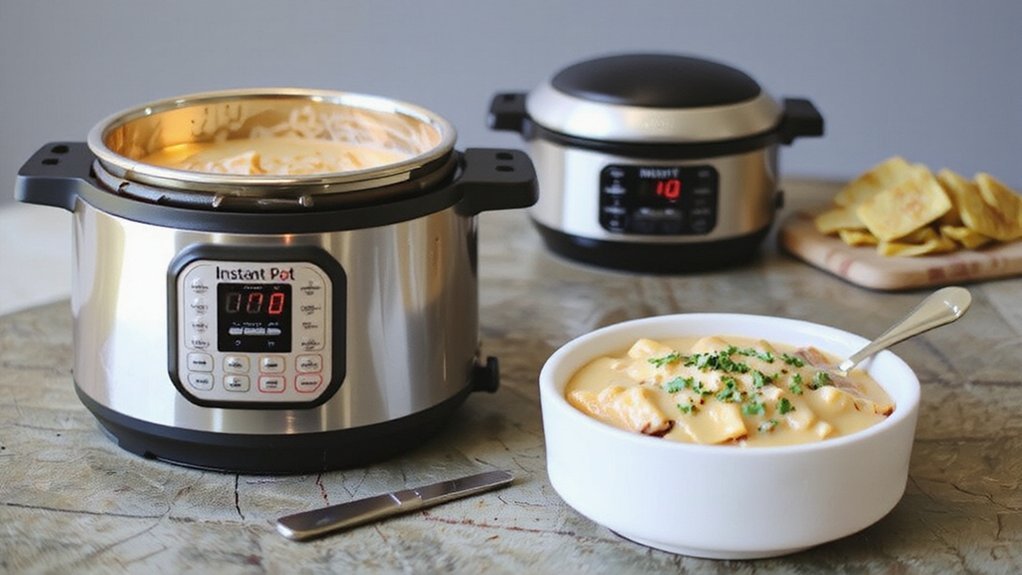
After you’ve measured the ingredients, gather the tools that will make the recipe repeatable and tested. You’ll need a 6‑quart Instant Pot (or similar 5–8 qt model), 12‑inch silicone spatula, 2‑cup liquid measuring cup, and a 1‑teaspoon to 1‑tablespoon nesting spoon set. Add a fine‑mesh strainer for rinsing pasta if desired. For safety, include a pair of heat‑resistant kitchen gloves and a silicone trivet — note these as safety accessories. Prep a small saucepan lid or plate for resting the hot inner pot. For finishing and service, have a 2‑cup mixing bowl and a 1‑cup ladle. Finally, keep microfiber cloths and nonabrasive brushes as cleaning tools. Lay everything out on a clear counter, numbered 1–8, before you start. Confirm calibrations of your Instant Pot.
Step-by-Step Pressure Cooking Instructions
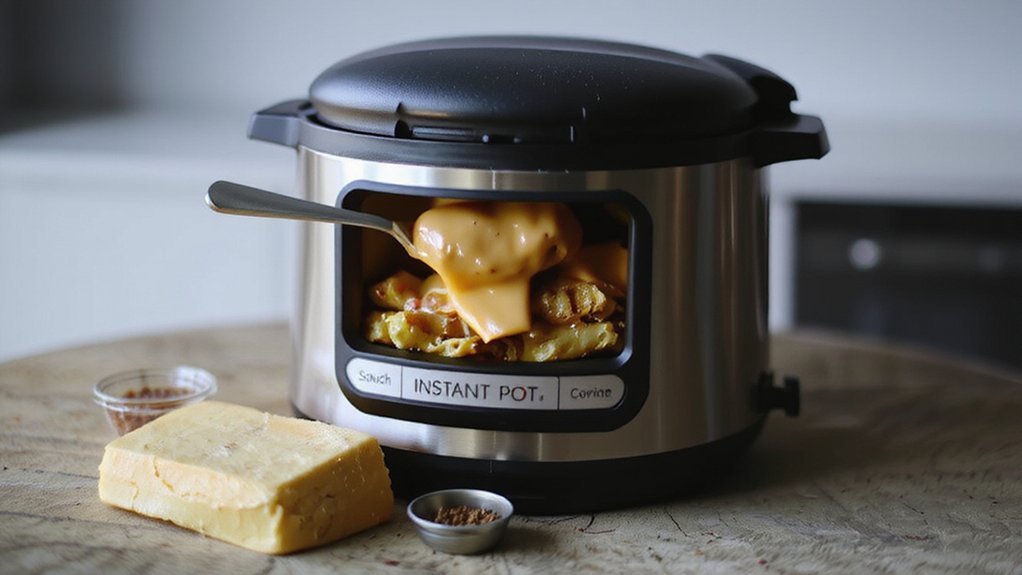
You should measure 12 oz dried elbow macaroni, 3 cups water, 1 tsp salt, and 2 tbsp butter into the Instant Pot. Lock the lid, set to High Pressure for 4 minutes, and make sure the valve’s sealed. You’ll allow a 5-minute natural release, then carefully quick-release any remaining pressure before opening the lid.
Prep and Measure Ingredients
Before starting, measure 2 cups (200 g) dried elbow macaroni, 3 cups (720 ml) low‑sodium chicken broth, 1 cup (240 ml) water, 4 tablespoons (56 g) unsalted butter, 1 teaspoon kosher salt, 1/4 teaspoon freshly ground black pepper, 2 cups (200 g) sharp cheddar cheese (finely grated), and 1/2 cup (120 ml) whole milk; grate the cheese and set 1/2 cup aside for topping. Next, confirm Portion Sizing for your crowd: this yields four generous servings. Lay out measuring cups, scale, and a small bowl for the reserved cheese. For Prep Timing, allocate 10 minutes to measure and grate, five minutes to melt butter and combine liquids in the pot. Double ingredients for larger batches. Keep ingredients organized by step to streamline workflow efficiently.
Set Pressure and Time
Place the measured 2 cups (200 g) dried elbow macaroni into the pot with the 3 cups (720 ml) chicken broth, 1 cup (240 ml) water, 4 tablespoons (56 g) melted butter, 1 teaspoon kosher salt, and 1/4 teaspoon black pepper, making sure the pasta is mostly submerged. Lock lid and set valve to sealing. Select Manual/Pressure Cook on High pressure and program 4 minutes; this tested time yields tender pasta without mush. Confirm display shows High and 4:00. If you’re at high elevation, add 1–2 minutes per 1,000 ft as altitude adjustments require; test once and refine. Perform quick safety checks: verify steam path is clear and lid is engaged. Start cook and monitor display; timing begins after pressure builds for consistent results.
Natural Vs Quick Release
When the cook cycle ends, use quick release to stop carryover cooking and preserve al dente texture: immediately move the valve to VENTING with a long utensil or oven mitt, keeping your hands and face clear of the steam path. Step 1: Wait 30 seconds to confirm pressure drops from HIGH to NORMAL. Step 2: Release fully; expect 10–20 seconds of strong steam — stand 12–18 inches back to avoid steam hazards. Step 3: Open lid away from you. For creamier results, use quick release for 0–2 minutes then stir and rest 2 minutes; this balances sauce cohesion and texture impact. Use natural release (10 minutes) only when you want softer pasta. These tested measures yield consistent mac and cheese with predictable, repeatable results.
How to Achieve Extra Creaminess
Starting with the right liquid and dairy balance, use 2 cups water plus 1 cup milk (or 1 cup milk + 1 cup half-and-half) for 8 oz (about 2 cups) dried macaroni. You’ll finish creamy mac by controlling temperature, starch, and fat. After pressure-cooking and quick release, do this:
Start with 2 cups water and 1 cup milk for 8 oz pasta; finish creamy by managing heat, starch, and fat
- Stir in 1 cup warm milk gradually while tempering dairy to prevent curdling.
- Add 2 tablespoons butter and 2 tablespoons cream cheese as emulsifying agents; whisk until glossy.
- Off heat, fold in 1/2 cup shredded cheese and 1/4 cup reserved pasta water to adjust viscosity.
Taste and adjust salt. You’ll get repeatable, silky results by sequencing heat, dairy addition, and measured agitation. Document each trial and note ratios for consistent innovation daily.
Cheese Selection and Substitutions
After finishing the milk-and-emulsifier stage, select cheeses by role and stick to tested ratios: for 8 oz (about 2 cups) dried macaroni use 1 cup (≈4 oz) melting cheese + 1/2 cup (≈2 oz) flavorful/aged cheese. Step 1: you choose a primary melting cheese — mild cheddar, fontina, or American — for smooth melt; measure 1 cup shredded. Step 2: add 1/2 cup grated aged cheddar, Alpine, or Manchego for bite and Aging effects; measure by volume, then weigh if precise. Step 3: if exploring Regional varieties, substitute one-third of the flavorful cheese with a regional specialty (smoked Gouda, Porto, or raclette) but keep overall ratios. Step 4: melt over low heat, stirring until homogenous. Test and adjust salt; serve immediately for ideal texture.
Add-Ins and Mix-Ins
How will you keep add-ins from turning the mac too wet or clumpy? You’ll control moisture and texture with measured additions and timing. Roast 1 cup diced bell pepper or 1 cup broccoli, drain, then add after pressure release. Sauté 6 oz cooked bacon or use 1 cup shredded rotisserie chicken, toss with 2 tbsp melted butter to prevent clumping. Fold 1/2 cup grated Pecorino off-heat.
- Add vegetables after pressure release; reserve 2 tbsp cooking liquid.
- Incorporate proteins warmed and lightly oiled.
- Fold delicate cheeses last, 30 seconds off-heat.
Use Regional Inspirations and Pairing Themes to guide amounts and boldness; test flavors in 1/4-cup increments. Adjust salt by 1/4 teaspoon increments, note results, and record each successful combination for repeatable innovation.
Troubleshooting Common Issues
If the dish doesn’t turn out as expected, diagnose by symptom and follow these tested fixes. If pasta is undercooked: check you used 8 oz (about 2 cups) dry elbow pasta with 2 cups liquid; reseal and pressure-cook 1 minute on high, then quick-release. If sauce is thin or soupy: stir off-heat and simmer on Sauté 2–3 min, or whisk in 1–2 tbsp cornstarch slurry (1 tsp cornstarch + 1 tbsp cold water) and simmer 1 min. If sauce is grainy or separated: remove pot from heat, whisk in 1–2 tbsp cold butter or 2–4 tbsp cold milk/cream gradually. If pasta is dry or clumpy: stir in 2–4 tbsp reserved cooking liquid or warm milk and fold gently off-heat. If you get a Burn notice: turn off, add 1/2 cup hot water, deglaze bottom with a wooden spoon before resuming. If pot won’t build pressure: check sealing ring, vent position, and confirm at least 1 cup liquid. Note Burn Signals and Starch Clumping.
Make-Ahead, Storage, and Reheating Tips
When you need to make this ahead, cool the mac and cheese uncovered at room temperature for no more than 20 minutes, then transfer into airtight containers in single-serving (about 1 to 1½ cup) portions and refrigerate within 2 hours.
- Label: date, portion size.
- Freeze: 2-cup bags flat.
- Thaw: fridge 12–24 hours.
For Batch Freezing, remove excess air and freeze flat for up to 3 months. Use Portion Planning to reserve one serving per meal. Reheat tested: place 1 cup mac and cheese in a 1-quart microwave-safe bowl, add 2 tbsp milk, cover loosely, microwave at 70% power 90 seconds, stir, repeat 30–60 seconds until 165°F. Oven alternative: 350°F for 20–25 minutes covered. Label dates and rotate stock; follow FIFO for best freshness consistently.
Conclusion
1. Taste and adjust: you’ll add 1/2 teaspoon salt or 1 tablespoon butter if needed. 2. Serve or store: you’ll portion into airtight containers, cool 30 minutes, refrigerate up to 3 days or freeze 1 month. 3. Reheat: you’ll stir in 2–4 tablespoons milk per serving and microwave or warm on low, stirring until smooth. Follow these tested steps and you’ll get reliable, creamy Instant Pot mac and cheese every time. No guesswork, just results.