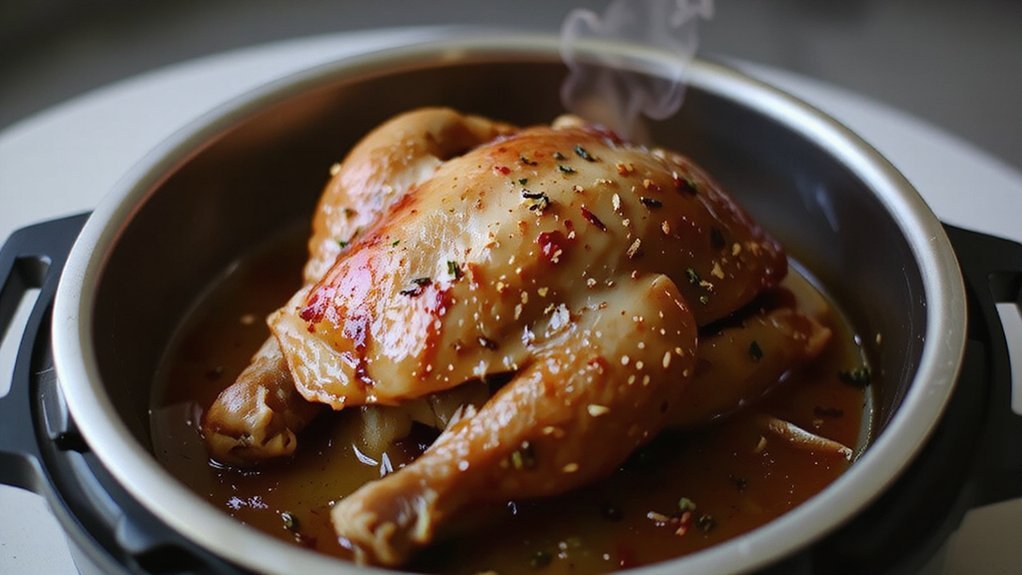
You’ll truss a 3–4 lb whole chicken, season it with 2 tsp kosher salt, 1 tsp black pepper, 1 tsp paprika and 1 tbsp olive oil, then place it on a trivet over 1 cup chicken broth in the Instant Pot. You’ll pressure cook on High for 25 minutes with a 10-minute natural release, then broil briefly for color—keep going to see exact timing, technique and tips for crisp skin.
Key Takeaways
- Trim, pat dry, season with 1 tsp kosher salt and rub under/over skin for even flavor before cooking.
- Use trivet, 1 cup broth, breast‑side up; pressure cook high 25 minutes for a 3–4 lb bird.
- Let natural release 10–12 minutes, then quick release to finish depressurizing safely.
- Pat dry, then broil 4–6 minutes or sear 2–3 minutes per side to achieve rotisserie‑style crispy skin.
- Confirm 165°F (74°C) at the thickest breast; if under, reseal and pressure cook 3–5 minute increments.
Ingredients and Equipment
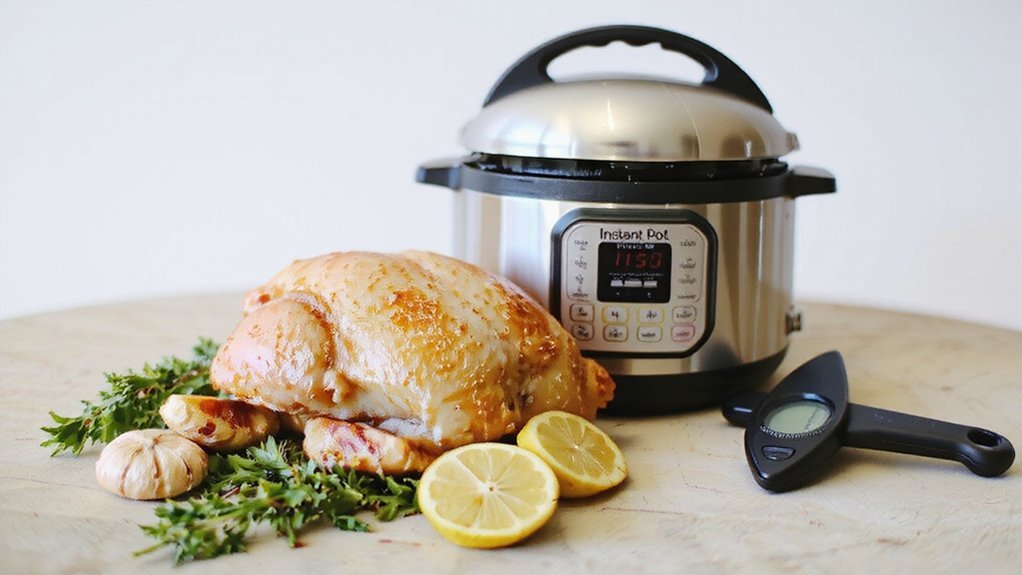
Gather the following precise items before you start: a 3–5 lb whole chicken (trim excess fat, pat dry), 1 tsp kosher salt per pound, 1/2 tsp ground black pepper per pound, 1 Tbsp neutral oil; aromatics—1 medium onion halved, 4 garlic cloves smashed, 1 lemon halved; 1 cup low-sodium chicken broth or water. You’ll also need an Instant Pot 6-quart (sealing ring clean), trivet with handles, and a chef’s knife. Use an accessory checklist to confirm: tongs, kitchen shears, meat thermometer, cutting board. Prioritize safety equipment—oven mitts and a silicone spatula—when releasing steam and lifting the trivet. Measure precisely, position the chicken breast-side down for browning, pour broth to deglaze, and lock lid. Adopt tweaks: adjust salt by weight, record results for repeatable innovation.
Spice Rub and Seasoning Mix
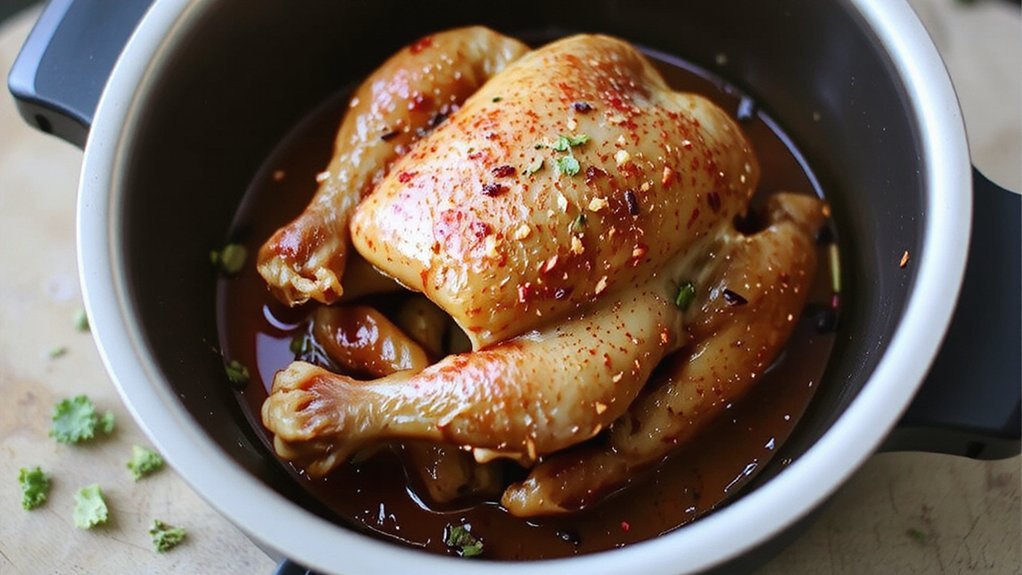
Now that you’ve patted the chicken dry and applied the baseline salt and pepper, make the rub: in a bowl whisk 1 tsp smoked paprika, 1/2 tsp ground cumin, 1/2 tsp garlic powder, 1/2 tsp onion powder, 1/4 tsp dried thyme, and 1/8 tsp cayenne (omit for no heat); add 1/4 tsp kosher salt if you want extra surface seasoning beyond the 1 tsp/lb baseline. Use measured pressure: coat skin evenly with 1 to 2 tablespoons oil, then press 1 to 1.5 teaspoons rub per quarter of bird, concentrating under wings and cavity rim. For innovation, experiment with micro Heritage blends—small proportions of fenugreek or sumac—to accent roast notes. Remember Salt chemistry: adjust total salt to prevent oversalting when brining or using compound salts.
Prep, Trussing, and Flavor Enhancements
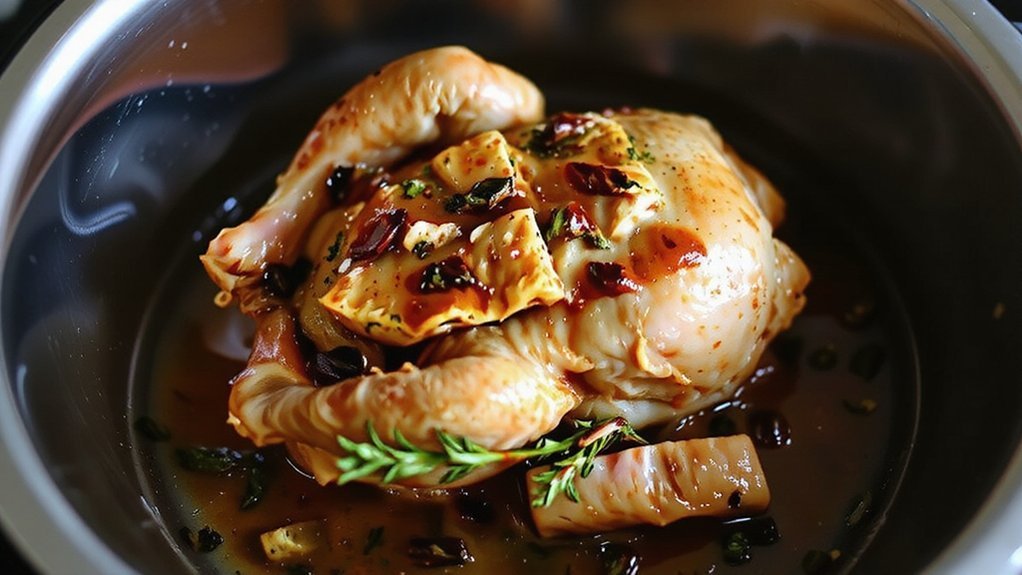
You rinse the cavity and exterior with cold water, then pat the chicken dry with paper towels until the skin feels dry, about 8–10 swipes. You truss with a 12–14 in kitchen twine: cross the legs, tuck wing tips under the shoulders, and pull tight in a single knot for compact, even cooking. You season with 1–2 tsp kosher salt per lb and 1 tsp ground pepper, rub 2 tbsp olive oil or spread 3 tbsp marinade under and over the skin, and refrigerate 30–60 minutes.
Cleaning and Patting Dry
Before handling the bird, remove the giblets and neck from the cavity and discard or reserve them for stock; avoid rinsing the chicken to prevent cross‑contamination. Use a Sanitation checklist: wash hands 20s, sanitize surfaces, gloves, Paper towels ready. Pat chicken dry inside and out with 2–3 paper towels, 10–15 seconds per area, to remove surface moisture for browning. Trim excess fat with shears. Press a resealable bag around the breast to reduce air layer and tighten skin. Rest uncovered on rack 10 minutes to equalize surface moisture. Final tactile check: skin should be matte and faintly tacky before seasoning.
| Tool | Action | Time |
|---|---|---|
| Gloves | Put on | 5 s |
| Paper towels | Pat dry | 10–15 s/area |
| Shears | Trim fat | 30 s |
| Rack | Rest chicken | 10 min |
Simple Trussing Techniques
With the skin matte and faintly tacky after patting, move directly to prepping and trussing for even cooking and stuffing retention. Lay a 20–24-inch length of butcher’s twine; center under tail, bring ends up alongside thighs, cross twice, pull snug to close cavity. Use a 12–15-inch loop to secure legs with a bow knot; trim to 1/4 inch. Employ two knot variations: classic surgeon’s knot for security, slip knot for quick release. Tucking methods: tuck wing tips under shoulders and fold skin flap over neck to prevent tearing. If stuffing, insert thermometer probe through knotless gap. Aim for 1–2-pound bird balance: adjust tension so thigh movement is minimal but skin isn’t distorted. Practice three times for consistency. You’ll gain precision and faster, repeatable results.
Seasoning and Marinades
Marinating the chicken concentrates flavor and improves moisture—use a dry-brine for speed: sprinkle 1 tsp kosher salt per pound evenly under the skin and inside the cavity, add 1/2 tsp black pepper per pound, then rub a paste of 1 Tbsp olive oil, 1 tsp garlic powder, 1 tsp smoked paprika, and 1 tsp dried thyme over the skin; massage 1–2 minutes and refrigerate uncovered 1–24 hours. Build flavor layering: combine 1 tsp citrus zest, 1 Tbsp chopped parsley, and 1 tsp crushed fennel; tuck under skin. If you use an acid, control acid balance: 1 Tbsp lemon juice or 1 Tbsp yogurt per bird for 30–60 minute marinades. Truss with thighs snug to preserve juices. Pat dry before Instant Pot sear for browning.
Pressure Cooking Steps and Timing
Once the trivet and 1 cup (240 ml) of broth or water are in the pot, place the 3–4 lb (1.4–1.8 kg) chicken breast-side up on the trivet, seal the lid, and set the cooker to High Pressure: 25 minutes for a 3–4 lb bird, adding 5 minutes per additional pound (e.g., 30 minutes for 5 lb). Use natural release for 10–12 minutes to stabilize juices; then perform a quick release to fully vent. Monitor device-specific pressure profiles and adjust cook time only if altitude or a denser bird demand it. Let internal temperature reach 165°F (74°C) at the thickest part. If under, reseal and pressure cook in 3–5 minute increments. Record your release sequencing and times to refine results with future iterations periodically.
Searing or Broiling for Crisp, Golden Skin
After pressure cooking, pat the chicken thoroughly dry with paper towels and transfer it breast-side up to a rimmed baking sheet; brush the skin with 1 tbsp neutral oil and sprinkle 1/2 tsp kosher salt and 1/4 tsp black pepper evenly. Preheat broiler to high (500°F/260°C) or heat a cast-iron skillet over medium-high. Use these steps to achieve crisp skin while preserving juiciness and exploiting Maillard chemistry and controlled Temperature gradients:
- For broiling, place sheet 6–8″ from heat, broil 4–6 minutes per side, watch for even browning.
- For searing, pat dry again, sear 2–3 minutes per side until deep golden.
- Rest 8 minutes to equalize Temperature gradients.
- Optional: finish with 1 tsp butter for sheen and flavor.
Monitor skin color rather than time alone.
Serving Suggestions and Leftover Storage
When carving, let the chicken rest 8 minutes, then slice the breast into 1/2″ (12 mm) thick pieces and quarter the legs; this yields efficient portions (3–4 servings for a 3–4 lb/1.4–1.8 kg bird) and preserves juices. You arrange slices on a platter, drizzle 1 tsp vinaigrette per 4 oz portion, and sprinkle 1/4 tsp salt. For Sandwich Ideas, layer 3 slices (≈4 oz) with 1 tbsp aioli, 2 leaves arugula, and 2 slices tomato on a 6″ roll; serve hot.
Store leftovers within 2 hr in sealed containers: whole pieces in 1 qt container or sliced in 2-cup (480 mL) portions. Use Reheat Methods: microwave 60–90 seconds at 70% power covered, or oven 325°F (160°C) for 10–12 minutes covered. Consume within 3–4 days.
Conclusion
You’ve pressure-cooked a 3 to 4 lb whole chicken on high for 25 minutes with 1 cup (240 ml) broth, performed a 10-minute natural release, then broiled 3 to 4 minutes per side to crisp skin. Rest the bird 10 minutes tented to redistribute juices; carve with a sharp knife, cutting along the breast and making 1/2-inch slices. Reserve 1/2 cup pan juices for serving. Follow these steps every time, no guesswork.